|
Keith Griffin
Sixteenth months ago, I led my last service in the parishes where I had served as vicar for nearly 23 years, and since then I haven’t been in any church on a Sunday morning. That June day, I took as my text, “The LORD will lead me to a wide, open space,” from Psalm 18, and it was the wide, open spaces I looked forward to as I walked through the church door for the final time. It was the end of June when I finished, thirty years almost to the day since my ordination as a deacon. So, initially I was in the wide, open space of summer. Then, on the last Sunday of August I made my way to the local Quaker Meeting House, a place I had attended during a sabbatical 14 years previously, and where a good number of the faces were familiar. How fortunate I was to be able to sit on those wooden benches in that ancient building only about a mile from my house! Here, I found myself in the wide, open space of worship focused upon silence. I had spent many years leading the Anglican liturgy while at the same time feeling increasingly dulled by so much of it. Sundays spent struggling with, and usually omitting, the Creed, often dropping the Prayer of Humble Access, and now and again writing my own Eucharistic Prayer, confident that no one was going to report me to the liturgy police. But I was under no illusion that suddenly the Quakers were the community I’d always been looking for, as I could see that it didn’t scratch all my itches. However, I was thankful that someone had started up a monthly discussion group, which enabled me to get to know some of the Quakers – the true members, for I was only an attender. When it was time to move out of the Vicarage I transferred to a new Quaker Meeting House, again, luckily only a mile or so from my new home. A larger space, less aesthetically pleasing, and obviously a new band of souls. There are Sundays when the ministry shared coheres in a perfect, Spirit-led unity. But the other week, the lady to my left rose to her feet, and with a frail voice spoke the first verse of the hymn, “For the Beauty of the Earth,” sat back down, and that was all we received that day. So, I’ve been telling myself sternly to accept this new tradition on its own terms. To wish for something else would be like moving to Pakistan and complaining that they don’t serve fish and chips. Someone who once occupied the benches of that first Meeting House – though not in my time – was my friend, Brenda, who told me how she was allowed to sit on the back row working on her own translation of the New Testament. She went on to explain how on so many occasions the ministry being offered dovetailed perfectly with the particular text she was wrestling with that morning. A few weeks ago, Brenda died at the age of 90. Soon after you lose someone, it’s not unusual to think of questions which went unasked. Or you see a life framed in a new light. I’m sure I must have mentioned Feral Spirituality to Brenda and, thinking now, I feel like nominating her as one of its pioneers. Although Brenda was one of my parishioners, she came to church very much on her own terms: to the quiet Midweek Communion, to the Soup for the Soul discussion group, and offering a painting or installation to the Christmas art exhibition. It’s tempting to think that in another age Brenda would have been ordained, but the truth is that she didn’t want to have to navigate being on the inside of something while everyone else was on the outside. Most of my encounters with Brenda over twenty plus years took place in the barn or lounge at her seventeenth-century farmhouse, which sits on a hill overlooking the village. Here, she ran a non-residential retreat house and all kinds of courses. If Brenda discovered a new theologian, like James Alison, or a Biblical scholar, like Margaret Barker, before you could say “transubstantiation” she’d track them down and a group of us would either be welcoming them round the kitchen table, or on our way to a retreat in Lancashire or London, where we would sample their exciting teaching first-hand. For many, Brenda was a spiritual director. She could be trusted with secrets and helped people find a new direction on their spiritual journeys – not that you’d hear her using a cliché like “spiritual journey”. When I hit sticky patches in my own ministry, Brenda’s kind and wise insights were often like a torch, gently guiding me forward. Since leaving my parishes, Brenda was the one I was in touch with most of all, especially as I started attending her twice-weekly place of pilgrimage, the local junk market. Here, she delighted in the stalls with their endless bargains, the traders, and the ordinary – but for her, glorious – encounters with whoever crossed her path. Although it’s only been a couple of weeks, I can see now with fresh eyes how Brenda was my gentle companion in my wide, open space, and I know I’ve still got a long way to travel with her. I mustn’t say Never, but I’m pretty sure that my years in the Church have come to an end. Can one be called out of the priestly life as one can be called into it? Fortunately, I don’t need to work, and these days, I’m exploring a new vocation with my art. I enjoy where we live, and would happily be around this neighbourhood until the day of my own death. There’s the poetry group I’ve joined in the pub at the station, and new parts of the town to discover. It’s a simple life, popping into charity shops for collage material, visiting a café for eggs on toast, and walking the dogs through the local park. Recently, I’ve been to a couple of gigs in the small, intimate venues I prefer, but I’m yet to go to the cinema in the afternoon. It’s a great feeling, starting somewhere new, and now, when I get off the bus, I no longer hit my head on the wing mirror. Next spring, I may purchase a Senior Railcard. On Wednesdays I drive to the nearby hospital, but only for the stall set up by the high-quality bakery which is just a little too far from our house. Each Sunday, you’ll find me at the Quakers, although I’d also be open to joining another group of people of faith if I ever come across one. I go on looking for theology which re-shapes the way we conceive of God, and offers something dynamic and relevant for our ever-changing world. Thursday is bin day. It’s that sort of life in what still feels like a wide, open space – and I love it. I’ve lost a friend, but as Henry, my own spiritual director, who once knew her, advised me, “Nurture your ‘inner Brenda’ and you’ll be fine.” October 2026
1 Comment
I misspent time and energy in my early adulthood trying to understand how I should pray. I made the mistake of asking some professionals - monks, clergy. Mostly their responses included specific techniques. Valid as they may have been, they did not much work for me.
Later on I relaxed about all this. When required to pray during the liturgy - I was a priest by then - I used a minimum of words, avoided flimflam, and where I could, used unexpected formulations that related directly to human experience. Privately I moved from speaking to God to voicing the things that were on my mind, trusting that God might be paying some attention. Also, and maybe more importantly, instead of stepping out of 'ordinary' life and into prayer, I noticed that prayer slowly moved into ordinary life. It is not easy to explain this without it sounding glib. But it happened. In my twenties I encountered Simone Weil's claim that "attention is the rarest and purest form of generosity". That was not new to me, but her expression gave my nascent grasp of it far better understanding. I had long known that attentive listening to others was a valuable thing. I'd found the same to be true of attentiveness to non-human things, too. And all this without grasping. That's the thing: to be attentive without grasping. This is a clue to living spiritually: to seek self-emptying, not self-improvement. Too much self-improvement can cause trouble. Hugh Henry writes:
I have a friend who came to his Christian faith, as a young man, in a fundamentalist brethren church many years ago. He had been going through a painful personal crisis and found this church to be a place of warmth, acceptance and love, which was what he desperately needed. He also came to know & revere Jesus as they were always talking about Him. His spiritual journey has taken him some way since then, but he still remembers with gratitude what he found amongst that group of Christian men and women. Looking back he recalls with a smile that he disagreed with pretty much everything that the male preacher at the front used to say but reckoned that putting up with it was a small price to pay for the fellowship he found amongst the membership. I reckon that there is deep truth in his story: that the most effective Christian preaching is not to be found in words spoken from the pulpit, but in a loving community. Plenty of churches are just like that, although some are not. As St Francis is reputed to have said “preach the Gospel at all times, and if all else fails, use words.” My guess is that the churches that are like that are mostly small in size, and that the bigger they become the more difficult it becomes to be so. The Good News is that such small loving communities are not confined to churches. When one of my daughters died and I went with her sister to make arrangements for her funeral, I knew that she didn’t have anything to do with a church, but discovered that she’d been recently become a member of a social club where she she’d clearly felt welcomed and accepted. We met some of her friends there and held the wake after the funeral in the club where they made us feel very welcome. God felt as present amongst that group of men and women as She had been in the brethren church where my friend came to faith. The presence of the gracious and loving God is potentially found in communities anywhere and everywhere. I have another friend who left the church of which she’d been a member for many years because it no longer felt to her to be a welcoming and loving community. Instead she joined a ‘wild swimming’ group and found there all the things that had felt absent from her church. It was a friendly and mutually supportive community, and a felt sense of awe and wonder was frequently experienced while swimming in the river. I rarely attend worship in a church building these days and don’t feel the lack of it. I have my shed where I pray every day. I have a rich community of friends with whom I share spiritual conversations, most of them still alive, although many [poets, composers, artists and writers among them] are long dead. Mary Oliver a deeply spiritual poet wrote, that when she was young “I never met any of my friends, of course, in a usual way – they were strangers, & lived only in their writings. But if they were only shadow-companions, still they were constant, & powerful, & amazing. That is, they said amazing things, and for me it changed the world………My great ones have taught me to observe with passion, to think with patience, to live always caringly.” I walk pretty much every day in the natural world, where I am aware that the birds, and the grasses, the trees, the flowers, the animals, the earth, the river, the wind and the light from the Sun, are all worshipping the God Who called them into being, in their various ways. In their midst I am aware of being part of world-wide community embracing all creation. The Cosmic Christ is everywhere you look if you have ‘eyes to see and ears to hear’ Him, and I have found Him, and continue to find Him, in all manner of communities. Unlike my friend I have no need to put up with the judgemental, rule-giving language that church worship frequently uses with reference to God, for the God Whom I have found, or more accurately has found me, is an unconditionally loving God, the God Whom Jesus Himself knew. Originally posted at contemporaryspirituality.blog Henry writes: The Bible has significant references to boats. The most familiar being the Ark into which Noah and his family took two of every species of animal to survive the Flood and then repopulate the Earth. It was a place of refuge and renewal. Boats feature in the Gospels too. Jesus called some of His first disciples to leave their boats and to follow him. On one occasion Jesus got into a boat in order to preach to a crowd on the beach. Famously he fell asleep in a boat with His disciples and had to be woken to save them from a threatening storm. I suspect that latter story was treasured by the members of the early church as it spoke to them when they faced persecution and troubles, encouraging them to trust that their Risen Lord would look after them come what may. Since then the Church has often seen itself as a modern day Ark, a place of shelter in dangerous waters, into which the Church calls people to come and be saved. ‘There is no salvation outside the Church.’ But today I found myself looking at a drawing by Rembrandt of a different story involving Jesus, His disciples and a boat, only in this one He is walking on the water and inviting them to get out of the boat, and to trust Him that all would be well. Peter finds this challenging and begins to sink until Jesus reaches out to him. Another disciple is lowering himself into the water while a third looks on. The boat meanwhile seems to be about to sail on without them Might this be a ‘Feral Icon?’ It shows that some people are invited not to get into the boat, but are instead called by Jesus to get out of it. Not least because Jesus is to be found outside the boat rather than inside it. It’s a calling that required and requires a good deal of trust [faith] in the One Who calls.  Hugh writes: I am poor company in art galleries. I much prefer powering through alone and stopping only when a canvas arrests me. I have previously written about the effect encountering The Subway (1950) by George Tooker had on me in New York. I had a similar experience on seeing this painting of The Last Supper in Bruges.  The artist is Gustave Van de Woestijne (1881–1947), a Belgian expressionist painter. He entered the Benedictine order in Leuven in 1905, but quickly sensed that monastic life was not for him and left after four weeks. Maybe their pre-admission preparation was not up to the mark.
He remained a Christian. An expression of this is seen in this monumental portrayal of the Last Supper. It has something of the feral to it, don't you think? Through it he expresses criticism of convential artistic piety: "Away with this saccharine, stultifying, strait-laced religious art! We’ve had enough of it, and our Catholic Church is already crammed full of all kinds of such bland stuff. […] I am neither edified nor affected when I enter our churches and look at the modern ornaments, statues or paintings, on the contrary, I have the urge to curse". His style was considered blasphemous by some. An encouraging sign. Fortunately, he found support from the van Buurens, Brussels art collectors who bought many of his works and, in 1927, sponsored a trip to Florence that allowed him to study fresco art. This canvas reflects his interest in fresco painting and his quest for modern religious art. Why does it strike me so? For a start, it is not mannered or pretty. No halos or pious expressions. No looking up, heavenwards. The proportions of the canvas (taller than it is wide) requires that the disciples huddle close. Something important is happening - draw near, it calls. There is no iconography, only the essentials: wine and a loaf of bread. And the bread is an ordinary loaf, no delicate host. It belongs in the ordinary transaction of heavenly realities. The apostles depicted here could be miners or labourers or fishermen. Hairstyles are those of the 1920s, pitch black, neatly combed. There is a sad solemnity in their grave faces. Jesus’ passion happens every day again. Jesus’ hair and beard are red, along with the wine and along with the hair of the figure on the lower left. Judas, maybe? Jesus looks towards him. I can't reliably read his expression. Van De Woestijne's picture has no extras, only the essentials - table, people, bread, wine - needed to depict the Last Supper. These betoken solidarity (God with us), tragedy, longing, love. The building bricks of our human adventure. Hugh Valentine Henry Morgan
This piece has been some time in its gestation, it’s something that I sense has been revealed to me over a period of time, and that it's now time to share it. I sense that there is truth in it. I might of course be wrong, or there might simply be bits of truth in it. So, I’d welcome your comments reader, on what I’m sharing here. (click 'Read More') 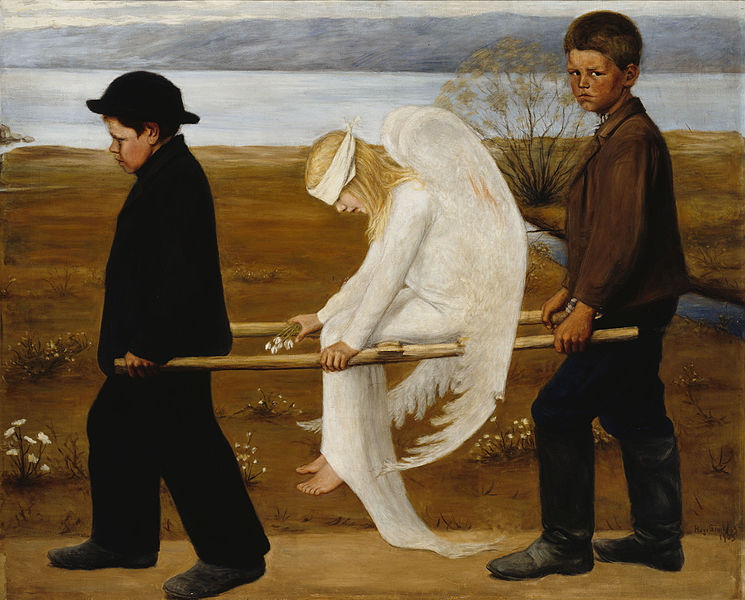 Henry writes: I enjoy looking at paintings. They often slip under my guard and take me by surprise. I sense that they speak, and my soul hears them before the rest of me catches up. One painting that does this for me is this one.
Henry's brother Pete considers the value of being 'feral' from his perspective, drawing on his practice as a social worker
As Henry’s brother, my “back story” is very similar to his, namely treading the academic treadmill of grammar school with “O” followed by “A” Levels followed by university – terminology that shows my age if nothing else! – in a family where we and our Mum were regular C of E worshippers and our Dad was a regular member of the local Quaker Meeting... I recently used Henry’s “Feral Christian” Paper as a discussion document at our recent Franciscan group meeting. The mere introduction of the concept seemed to provoke strong negative thoughts right from the outset. One member had come armed with a print-off from an American website by Dr.Jeff Myers, President of Summit Ministries, belittling “feral Christians” but written from the standpoint of “an educator and entrepreneur”.
I don’t know if I have gone off at a tangent or missed a point or merely revisited and rehearsed age-old musings but I have enjoyed reflecting on feral spirituality...
I’m a vicar who has worked in a beautiful part of northern England for over two decades. Every year I am required to take part in a ministerial development review (MDR), when I meet with either my local Bishop or Archdeacon. It’s an opportunity to talk about my progress in ministry, how my work is going, and who I am beyond parish life. Usually, it’s a helpful and painless process, but it does involve filling in forms. Fair enough. However, when you get to the end of the form, you are asked to come up with some priorities, as well as review progress on your priorities from last time....
When I began training for the priesthood the Church was still unwilling to accept women into this ministry. As a member of MOW (Movement for the Ordination of Women) we marched, raised our voices and eventually fought our way into the church. It had been a struggle for me in other ways too; not only was I a woman but a divorced one at that. Oh dear, the hoops I had to jump through but eventually I was accepted as an ordinand....
On holiday a few years ago I read a book by George Monbiot who writes for The Guardian on environmental matters. In it he makes an eloquent plea for the re-wilding of some of our moorland areas. But what drew me was the book’s title: Feral. I wasn’t sure why I was drawn in until I read his definition of ‘feral’ as being “in a wild state, especially after escape from captivity or domestication.” And then the lights came on....
I often go into Church buildings. They are usually calm, tranquil environments in which to reflect and/or meet and relate to other people - a social and spiritual space. Here can be found God and prayer. I spend significantly more time in other spaces and buildings which would be classified as 'secular'. They can also be peaceful and calm places to reflect and meet other people - a place to explore both oneself and others. Here can be found God and prayer and in this context I would also classify them as 'spiritual' places...
They say familiarity breeds contempt, but that’s too blunt a claim. Familiarity can also nurture love and nuance and wisdom. In the life of the regular churchgoer, a growing and reinforced familiarity with scripture and liturgy can foster depth and thoughtfulness, which – goes the theory – find an ever deeper expression in the world beyond the church...
The word ‘feral’ was initially a seed sown through conversations with Henry Morgan. My sense of being a ‘boundary-dweller’ through much of my ordained ministry as a parish priest, and as a spiritual director/mentor, persisted up to and beyond my retirement from full time ministry. My sense of person-centred vocation, in which I sought to recognise Christ amongst those I lived with, frequently felt to be increasingly at odds with the thinking and planning of the institutional Church. This is not a criticism of any particular individuals, but what I perceived to be a growing trend towards a management strategy that became more concerned with the institution’s own ‘salvation’ rather than the ‘care of souls’.
I suppose I took my first steps in being feral many years ago when I was a curate in my first parish and I took “Oh Sod It” days at times other than my day off just to get away and just BE. It might be going for a picnic or wandering a city centre: I would just get up knowing that I couldn’t face being dutiful that day...
There is little understanding amongst the christian community of the need that drives (or leads?) someone to the fringes of orthodox Christian community. For myself, a Christian of nearly 40 years and, for much of that time, an ‘upstanding member of the community’, I have found it surprising to discover the need for a more meaningful faith has led me away from the church. It seems that there came a point where it was impossible not to explore a spiritual path that was off the main highway...
A feral animal is one not now owned or controlled by anyone having returned to an untamed state from domestication. In human terms, it might be someone "abandoned by – or escaped from – society", "living outside the mainstream", "beyond the control of rules, regulations and accepted norms."...
"To my knowledge he never identified himself as practising feral spirituality, but I think the idea would have appealed. It was partly the closed and blinkered nature of the institutional Church that drove him and a handful of other young priests (along with their partners and wives) in the late 1950s to break with career expectations and prioritise simply living out Christian values in workplaces and working class communities, and seeing where the journey would take them."
Read more... |

 RSS Feed